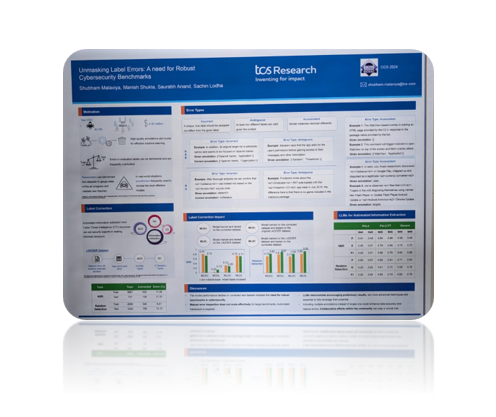
🧹 What if your “gold-standard” dataset is wrong—and your models quietly learn those mistakes?
This paper tackles a fundamental but often overlooked problem in modern AI pipelines: annotation errors and their cascading impact on model training, evaluation, and human-in-the-loop data cleaning systems.
We show that annotation error detection (AED) systems themselves break down under label noise, and that simple noise-aware training strategies can dramatically improve their effectiveness without changing model architectures or workflows.
📄 Work Overview 🔗
Venue: HILDA @ SIGMOD 2025
Focus: Data quality, annotation error detection, noise-robust training
As AI systems scale, the assumption that “expert-labeled” datasets are clean no longer holds. Even widely used benchmarks contain substantial label noise, which undermines both training and evaluation reliability.
This work examines how label noise affects AED systems and identifies practical training interventions that restore their utility at scale.
🎯 The Core Problem
Human-in-the-loop data cleaning pipelines typically follow this pattern:
- Train a model on labeled data
- Use model confidence or disagreement to flag suspicious labels
- Ask human experts to review flagged samples
However, this loop contains a hidden flaw:
If the model is trained on noisy labels, its ability to detect those very errors collapses.
This creates a paradox: AED systems rely on models that are most vulnerable to the noise they are supposed to detect.
🔍 Research Questions
This paper systematically investigates three questions:
- RQ1: Do standard deep learning training configurations work for AED?
- RQ2: How severely does label noise degrade AED performance?
- RQ3: Can noise-robust training strategies improve AED effectiveness?
🧠 Anatomy of an AED System
Most modern AED systems share a common structure:
- Base Model Selection (e.g., BERT-style encoders)
- Fine-tuning on Noisy Labeled Data
- Error Scoring or Flagging
- Flaggers: binary decision (error / no error)
- Scorers: continuous likelihood of annotation error
- Optional Multi-Model Aggregation
- Human Validation of Flagged Samples
This study focuses on AED methods that depend on model training, which dominate current practice.
⚠️ Key Insight: Noise Breaks AED
The experiments reveal a striking result:
Models trained with standard cross-entropy loss on noisy data suffer catastrophic AED performance collapse.
Across multiple NLP datasets:
- Performance drops by 80–90% on complex datasets
- Even simpler datasets see 20–30% degradation
In other words, training configurations that work well for prediction tasks fail completely for error detection.
🛠️ Noise-Aware Training as the Fix
Instead of proposing new AED algorithms, this paper takes a different approach; Fix the training dynamics. Two lightweight, widely applicable strategies are evaluated:
Robust Regularization
Constrains model outputs to prevent memorization of noisy labels by limiting extreme confidence.
Key effect: Reduces overfitting to incorrect annotations.
Robust Loss Design
Modifies the learning objective so that mislabeled examples exert less harmful influence during training.
Key effect: Stabilizes learning in the presence of conflicting or ambiguous labels.
📊 Experimental Findings
🔹 Noise-Aware Training Works
Across datasets and AED methods:
- Performance improves by 20–45%
- Both flaggers and scorers benefit
- Gains are consistent across multiple model families
🔹 Training Dynamics Matter More Than Architecture
Traditional ML models sometimes outperform large neural models when:
- Label noise is high
- Data is simple or separable
This reinforces a core data-centric insight:
Better training beats bigger models in noisy environments.
🔹 Massive Reduction in Human Effort
With noise-aware training:
- Only ~0.01–0.05% of samples are flagged for review
- Human experts validate hundreds of samples instead of tens of thousands
🛡️ Implications for Data-Centric AI
This work reframes annotation error detection as a training problem, not just a scoring problem:
- AED systems must be designed for noisy data by default
- Noise-aware training could be a first-class design choice in data cleaning workflows
🧾 Conclusion
This work demonstrates that annotation error detection fails silently when trained naively, but can be dramatically improved with simple, principled training adjustments. By aligning training strategies with the realities of noisy data, we can:
- Restore AED effectiveness
- Reduce expert burden
- Build more trustworthy AI systems
If you care about data quality, evaluation reliability, or human-in-the-loop AI, this work argues for one clear takeaway:
Clean models start with noise-aware training — not just better labels.